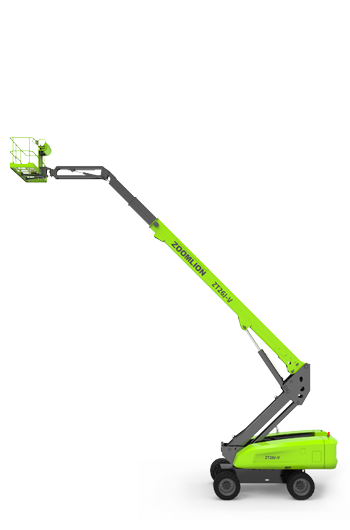
A telescopic boom lift may offer the working height needed for a demanding project, but height alone does not determine whether the machine can reach the jobsite successfully. Before delivery, contractors and rental teams should check gates, roads, turning areas, overhead clearances, ground conditions, and storage space. A machine that fits the reach requirement may still create logistical problems if its transport and operating dimensions are overlooked.
Start With the Access Route
The first dimensional check should happen before equipment is ordered. Measure gate openings, site entrances, road widths, bridge restrictions, temporary access lanes, and the routes leading to the planned operating area. The machine must be able to reach the work zone without encountering physical restrictions that were absent from the original equipment-selection discussion.
Height matters during transport as well as operation. Low bridges, building entrances, overhead signs, electrical conductors, tree branches, and temporary structures can limit movement. OSHA recommends assessing the work area for overhead obstructions, electrical hazards, and other site conditions before aerial-lift work begins. A delivery route should therefore be reviewed as carefully as the final work position.
Stowed Dimensions Affect More Than Transport
Stowed length, width, and height influence how equipment enters, exits, turns, and is positioned on a site. A long machine can require more room to negotiate a corner, while overall width can determine whether it passes through a restricted entrance. Stowed height can become critical when transporting the machine beneath structures.
These dimensions also influence where the equipment can be parked when not in operation. Construction sites may have limited storage areas, and the machine may need to be moved between work zones throughout the day. Checking the dimensional envelope in advance helps project teams identify whether additional traffic control, temporary access arrangements, or alternative positioning will be necessary.
Turning Radius Changes Site Planning
A boom lift may fit through an entrance yet still struggle with the next turn. Inside and outside turning radii should therefore be compared with actual road widths, corners, loading areas, and obstacles. This is particularly important on compact urban sites, industrial facilities, and projects surrounded by existing buildings.
Wheelbase and steering configuration can also affect maneuverability. Buyers should examine these specifications together rather than treating overall machine width as the only mobility indicator. A detailed site layout can reveal pinch points that are easy to miss when equipment selection focuses primarily on maximum working height and horizontal reach.
Ground Conditions Matter Too
Dimensions cannot be separated from the surface on which the machine will travel and operate. Uneven ground, slopes, soft soil, unfinished surfaces, and construction debris can affect machine movement and positioning. The planned route should be inspected before delivery, with operating areas checked for hazards and conditions that fall outside the manufacturer’s specified limits.
Project teams should also account for machine weight and ground clearance. These figures can affect access over temporary roads, ramps, surfaces, or transitions between different levels. Manufacturer instructions and site-specific risk assessments should determine whether the planned route and operating position are suitable.
Why Buyers of a Diesel Telescopic Boom Lift Should Check the Full Envelope
Buyers selecting a diesel telescopic boom lift often focus on working height, outreach, platform capacity, and terrain performance because these characteristics directly relate to the task. However, the machine’s complete dimensional envelope can determine whether those capabilities can actually be used at the intended location.
Procurement teams should compare stowed length, width, height, wheelbase, ground clearance, turning radius, and tail-swing requirements. Transport weight, tire dimensions, drive speed, gradeability, and steering mode may also affect logistics. HSE guidance emphasizes selecting the appropriate MEWP for the job and site conditions, reinforcing the need to evaluate the complete operating environment rather than a single headline specification.
The ZT26J From Zoomlion Access
The ZT26J from Zoomlion Access is a diesel telescopic boom lift with a 28.7 m maximum working height, 26.7 m platform height, and 22.1 m horizontal outreach. Its published dimensions include an 11.91 m stowed length, 2.49 m stowed width, and 2.82 m stowed height. The platform measures 2.44 m long and 0.91 m wide.
The ZT26J also has a 2.8 m wheelbase, 0.4 m ground clearance, 3.5 m inside turning radius, and 6.1 m outside turning radius. Its gross weight is 17,400 kg, with a listed 45% gradeability. The machine uses 4WD and front-wheel steering, while its standard solid tires are 385/65-24. These figures provide concrete parameters for transport and site-access planning.
How Zoomlion Access Covers High-Reach Applications
Zoomlion Access lists telescopic boom lifts across diesel, electric, extended-range hybrid, and crawler configurations. Its current global range includes diesel models from 20 m to 68 m, giving customers multiple reach classes for different applications. The company also provides scissor lifts, articulating boom lifts, spider lifts, and telehandlers as part of a broader MEWP portfolio.
For contractors and rental businesses, this wider lineup allows machine selection to be based on both work requirements and site logistics. The ZT26J combines a 28.7 m working height with a 22.1 m horizontal outreach, but its nearly 12 m stowed length and 2.49 m width must also be considered before deployment. Zoomlion Access therefore gives buyers measurable specifications to compare with real transport routes and project layouts.
Make Dimensions Part of Procurement
A high-reach machine should be evaluated from delivery point to final work position. For any telescopic boom lift, procurement teams can begin with a dimensional checklist covering entrance width, route height, turning space, operating clearance, ground conditions, weight, and storage requirements. These details can reveal constraints before transport arrangements are made.
For a diesel telescopic boom lift, the same principle applies even when the machine clearly meets the required height. The ZT26J demonstrates why working height, outreach, stowed dimensions, turning radius, weight, and terrain performance need to be reviewed together. With the published specifications from Zoomlion Access, buyers can compare the machine against actual site constraints before committing to delivery and deployment.
