Aluminium die casting is widely used for components that require complex geometries, consistent dimensions, and efficient production at scale. However, even a well-designed die casting process can produce defects when material conditions, tooling, machine settings, or part design are not properly controlled. Common aluminium die casting defects can affect appearance, dimensional accuracy, mechanical performance, sealing, and long-term reliability.
For manufacturers, identifying a visible defect is only the first step. The more important task is understanding why it occurred and whether the underlying process can be stabilized. HordRT approaches die casting quality through design review, tooling control, process optimization, and inspection, helping customers address potential quality risks before they become costly production problems.
What Causes Aluminium Die Casting Defects?
Aluminium die casting involves forcing molten aluminium into a steel mold at high speed and pressure. This creates a short and highly controlled filling process, but it also leaves little room for errors in temperature, flow, or timing.
Molten metal temperature directly affects fluidity and filling behavior. If the temperature is too low, the metal may begin to solidify before completely filling thin sections. Excessive temperature, meanwhile, can increase oxidation, soldering, and thermal stress.
Die temperature also influences solidification. Uneven temperatures across the mold can create inconsistent filling and cooling, increasing the risk of distortion or localized defects.
Injection speed and pressure are equally important. Inadequate filling conditions may result in misruns or cold shuts, while excessive turbulence can contribute to air entrapment and gas porosity.
The gating and venting system also has a major influence on casting quality. A poorly positioned gate can create unfavorable metal flow, while insufficient venting can prevent trapped air and gases from escaping.
Part geometry matters as well. Thin walls, sharp transitions, deep cavities, and uneven wall thickness can create difficult filling and solidification conditions. For this reason, defect prevention should begin during product and mold design rather than after production starts.
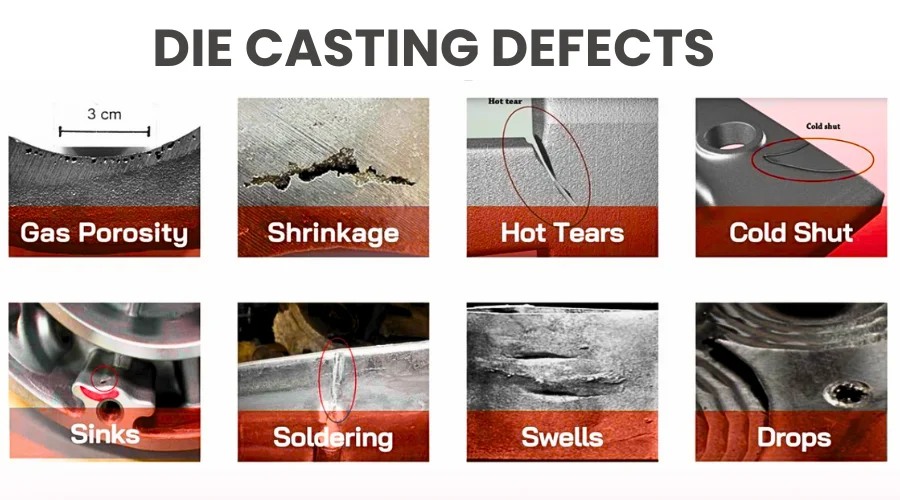
Eight Common Aluminium Die Casting Defects
Different defects reveal different problems within the casting process.
Gas porosity appears as internal voids caused primarily by trapped gas. Although it may not always be visible externally, it can reduce mechanical performance and create problems during machining or sealing.
Shrinkage porosity occurs when metal contracts during solidification and insufficient molten metal is available to compensate for the volume reduction. It is often associated with areas of concentrated material or poor feeding conditions.
Cold shuts form when separate streams of molten aluminium meet without achieving proper fusion. They may appear as visible lines or seams on the casting surface.
Misruns occur when molten metal fails to completely fill the die cavity. Thin sections, insufficient metal temperature, or unsuitable filling conditions can contribute to this problem.
Flash is excess aluminium that enters the clearance around the parting line, ejector pins, or other die interfaces. Excessive flash can indicate die wear, insufficient clamping conditions, or process instability.
Blisters are raised surface areas that can develop when trapped gas expands, particularly during subsequent heating or finishing processes.
Soldering occurs when aluminium adheres to the die surface. It can interfere with part release and gradually damage casting consistency if not controlled.
Warpage and dimensional distortion result from uneven cooling, residual stresses, or unsuitable part and die design. These issues can be particularly important when components must meet tight dimensional requirements.
How Are Aluminium Die Casting Defects Detected?
Inspection methods should match the type of defect being investigated. Visual inspection can quickly identify flash, cold shuts, surface blisters, and other external abnormalities. However, internal defects require more advanced methods.
X-ray inspection can reveal internal porosity and other discontinuities without destroying the component. CT scanning provides more detailed three-dimensional information and can help locate internal defects relative to the part geometry.
For components involving fluid or pressure containment, leak testing can determine whether internal porosity or other discontinuities affect functional performance. Metallographic analysis can further examine the material structure and help investigate the relationship between defects and solidification behavior.
Dimensional inspection is also essential for detecting warpage, distortion, and deviations from the approved drawing.
Die Design Has a Direct Impact on Casting Quality
A reliable die design does more than reproduce the desired component shape. It controls how aluminium enters, fills, and solidifies within the cavity.
Gate location affects filling direction and flow balance. Runner geometry influences how molten metal reaches different areas of the cavity, while overflow areas can help collect the initial metal flow and trapped gases.
Effective venting provides an escape path for air and gases during filling. Cooling channels should also be arranged to promote balanced heat removal and reduce localized thermal differences.
The parting line deserves careful consideration because its position can affect flash, dimensional accuracy, machining requirements, and overall mold complexity.
At HordRT, reviewing these factors during tooling development can help identify potential defect risks before the mold enters full production.
Process Parameters Determine Filling and Solidification Behavior
Even a well-designed mold requires appropriate process parameters. Metal temperature, die temperature, injection speed, and intensification pressure all influence how the cavity fills and how the casting solidifies.
The first-stage injection phase generally controls how molten aluminium moves toward the cavity, while the second-stage phase provides the high-speed filling required to complete the casting. The transition between these stages needs to be properly controlled.
Filling time is another important variable. Excessively slow filling can promote premature solidification, while unsuitable high-speed conditions may increase turbulence and air entrapment.
Rather than adjusting individual parameters independently, manufacturers should evaluate them as an interconnected process window. This approach makes it easier to identify stable operating conditions and maintain consistency between production batches.
Prevent Defects Before Mass Production
The most efficient way to manage aluminium die casting defects is to identify risks before large-scale production begins.
A DFM review can evaluate wall thickness, draft angles, ribs, holes, transitions, parting lines, and other features that may complicate casting. Mold-flow simulation can then provide insight into filling patterns, air entrapment, temperature distribution, and potential problem areas.
Prototype validation provides an opportunity to verify the proposed design and tooling approach. After that, process window development can establish appropriate ranges for critical production parameters.
First article inspection provides another important checkpoint before production is fully released. By combining dimensional inspection with functional and internal quality checks where necessary, manufacturers can identify issues while corrective action remains relatively manageable.
What to Look for in an Aluminium Die Casting Supplier
Quality control depends not only on the casting machine but also on the supplier’s ability to manage the entire manufacturing process.
Consider whether the supplier has appropriate die casting equipment, in-house or controlled mold design capabilities, and inspection resources suited to the component’s requirements. Process monitoring is equally important because stable production depends on maintaining critical parameters rather than inspecting defects only after they occur.
Quality documentation should also be clear enough to support traceability, first article approval, dimensional verification, and ongoing production control.
HordRT combines die casting, tooling development, machining, and quality inspection capabilities to support projects from initial design review through production. This integrated approach allows potential casting risks to be considered across multiple stages rather than treating defects as isolated production problems.
Turning Defect Control Into Consistent Casting Quality
Aluminium die casting defects are rarely caused by a single factor. Material temperature, mold design, injection parameters, venting, cooling, geometry, and equipment conditions can interact throughout the casting cycle.
For this reason, effective quality control should focus on the complete manufacturing process. Early DFM analysis, simulation, appropriate die design, controlled process parameters, and suitable inspection methods can significantly reduce the risk of recurring defects.
For projects where dimensional consistency, internal integrity, and production stability matter, working with an experienced die casting partner such as HordRT can provide a more structured path from component design to finished aluminium castings.
